What happened
OpenAI recently published a customer story about Ringg, an Indian voice-agent startup that automates customer support over phone, chat, and WhatsApp. The headline number: up to 65% of routine inquiries now get resolved without any human involvement, across more than 7 million connected calls a month.
Ringg isn’t a brand-new startup or a lab experiment. It started as DesiVocal, a text-to-speech tool, before pivoting into conversational agents. Back in August it closed a $15.5M Series A (Peak XV Partners led the extension), and it already runs production traffic for real, sizeable customers in India — Practo, Groww, Policybazaar, Flipkart — some handling over a thousand appointment bookings a day through it.
What actually changes: task-based model routing, not one model for everything
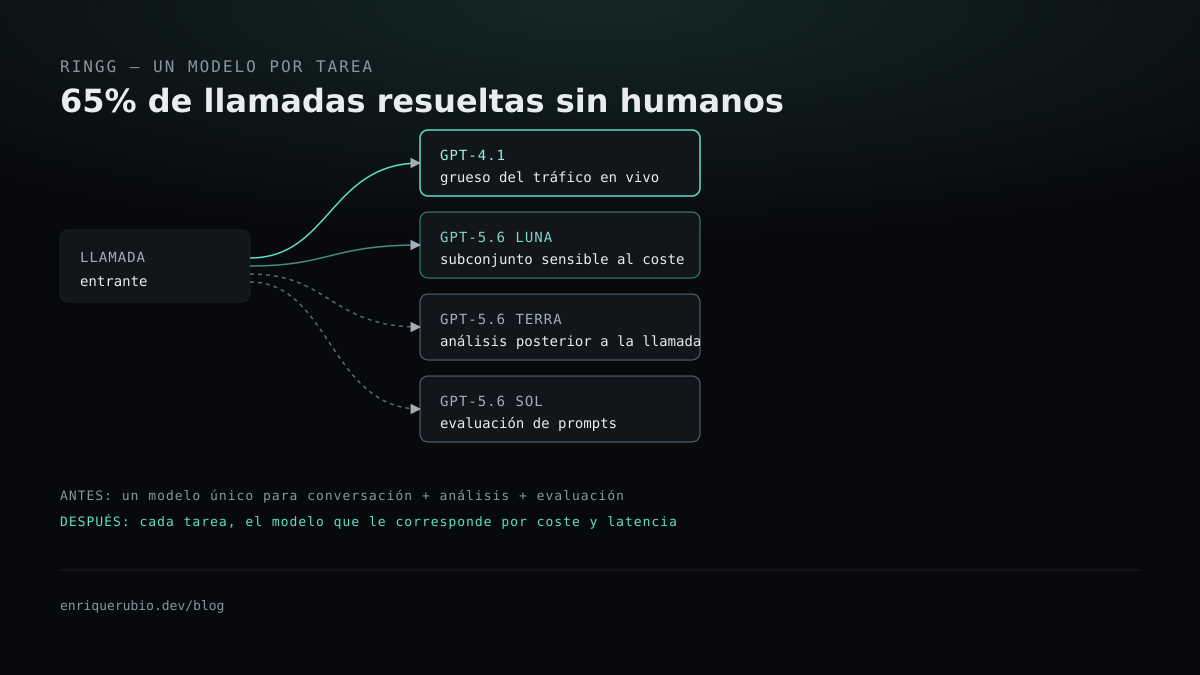
The interesting part isn’t the 65% — it’s how the system is built. Ringg doesn’t run a single model across the whole pipeline. It splits the work across four:
- GPT-4.1 handles the bulk of live voice and chat traffic — the default model for real-time conversation.
- GPT-5.6 Luna takes over a subset of that real-time traffic, specifically where cost matters more than peak capability — and there, per OpenAI, the switch cuts model cost by roughly 90% on that particular workload.
- GPT-5.6 Terra analyzes calls after they’ve ended — it doesn’t converse, it summarizes and classifies after the fact.
- GPT-5.6 Sol is used to evaluate and improve the system’s own prompts, closing the loop.
It’s a “one model per job” architecture rather than “one model for everything,” and that’s the part of this story with real value for anyone building LLM-based automation: you don’t have to pick a single model and force it to cover live conversation, batch analysis, and evaluation all at once. Each task has a different cost/latency profile, and handling them separately is what lets you bring cost down without touching quality where it actually matters — the live conversation the customer experiences.
The per-customer numbers
OpenAI and the coverage that followed break out three concrete cases:
- Policybazaar: 67% of calls handled without a human; response time dropped from 8-12 minutes to under 60 seconds.
- Practo: 85% first-call resolution, sub-3-second response times, a 70% drop in operating cost versus the previous human-led flow, and 1,000+ daily appointment bookings handled by the system.
- Groww: 72% self-service resolution on IPO/futures/options queries, with an average handling time of about 2 minutes.
The part worth reading carefully
Here’s the nuance the coverage itself flags, and it’s worth repeating: Ringg doesn’t publicly explain how it decides what counts as a “routine” inquiry. And if you look at the three customer cases above, each one reports a different metric — “handled without a human” (Policybazaar), “first-call resolution” (Practo), “self-service” (Groww). These are related ways of measuring, but they aren’t interchangeable, and none of them is literally the headline “65% of routine inquiries.”
That doesn’t make the numbers false — the response-time and operating-cost improvements are independently verifiable regardless of how “routine” gets defined. But it is exactly why comparing Ringg’s figure against any other voice-agent vendor’s (and there are several publishing similar-sounding numbers this year) is, for now, comparing apples to oranges. It’s the same problem you’ll see in any space where an “automation rate” becomes a marketing headline without a public, auditable definition behind it.
What to watch
Two concrete things: whether Ringg — or another vendor in the same space — ever publishes an operational definition of “routine” that lets you compare apples to apples, and whether task-based model routing, instead of one model for the whole pipeline, becomes the standard way these systems get built rather than a detail specific to one case study.
Why it matters
You don’t need to work in customer support, or in India, for this to be relevant. It’s a concrete, real-customer example of a pattern anyone building AI automation runs into sooner or later: splitting which model handles which task, instead of forcing one model to do everything, is what lets cost come down without the part the customer actually experiences — the conversation — getting worse.