The recording is the cheap part. Getting from a raw file of about 1.8 GB to a video I am willing to put on YouTube is where the work goes.
In an earlier article I described its first version: an editing agent I call Marcos, built for short-form clips. This is what the second version did with a real long-form job.
The job, in numbers
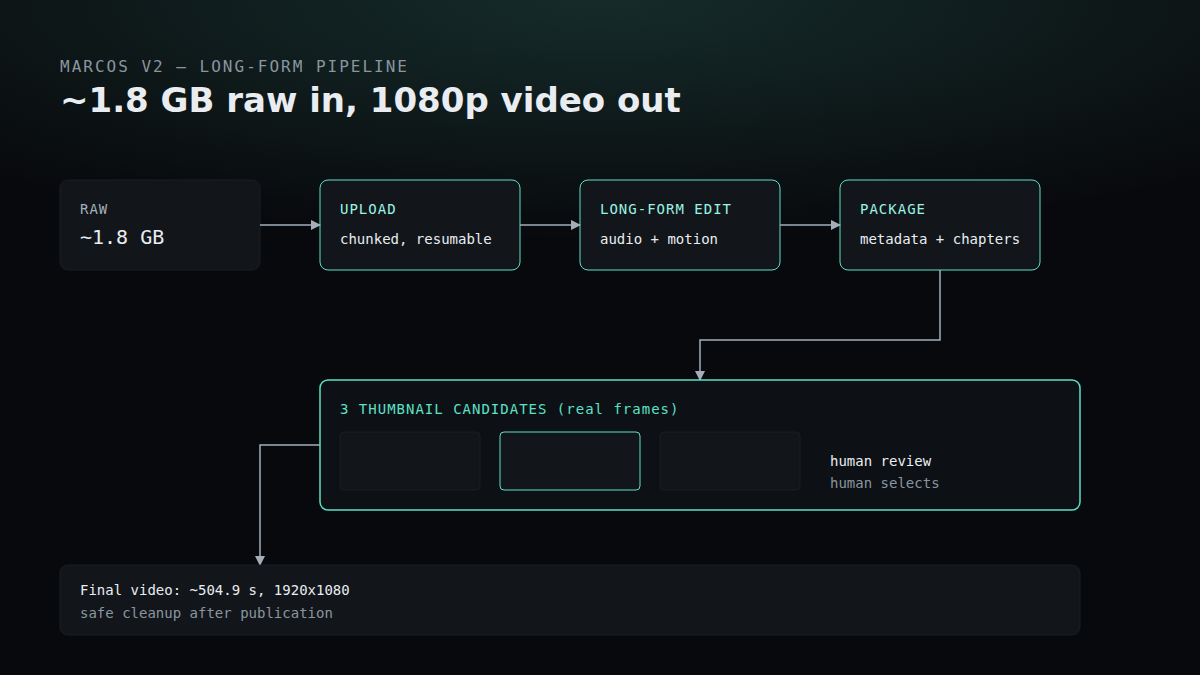
- Input: about 1.8 GB of raw video.
- Output: a finished video of about 504.9 seconds (roughly 8 minutes 25 seconds) at 1920x1080.
- Also produced: a YouTube metadata package, chapters, and three thumbnail candidates.
The production job reached a finished V2, which I reviewed manually and strongly preferred.
The engineering problem, step by step
1. Getting 1.8 GB to the server at all. A multi-gigabyte file is not a normal form upload. The uploader is chunked and resumable, with checksums, cancel, an idempotent completion step, and disk and resource guards. No editing job is created until the upload is finalized.
2. Long-form is not short-form. The system began as a short-form tool. V2 adds a long-form mode instead of stretching the short-form one.
3. Audio. The audio is mastered.
4. Motion. Motion graphics are added to the edit.
5. Everything around the video. A video on YouTube is also its metadata, chapters and thumbnail. The system produces a YouTube metadata package and chapters, and generates three thumbnail candidates from real frames of the video itself. I pick one, and the selection is downloaded.
6. Human review. I review the result before it is published. The system gets me to a finished video; it does not decide that the video is good.
7. Cleanup. The pipeline can now clean up local copies safely after publication, so a multi-gigabyte source file does not sit on the server indefinitely. That cleanup has been validated end to end on disposable production jobs; I am not claiming it was run on this particular job.
Where AI is used and where it isn’t
Not every step is a language model, and I don’t call the whole system “AI”. The accurate description is model-assisted planning and editorial reasoning, with deterministic media processing and validation.
- Model-assisted: interpreting the content and the transcript, editorial and planning decisions, generating the metadata and the packaging around the video, and semantic reasoning where it applies.
- Deterministic: resumable upload and file handling, FFmpeg execution and rendering, audio processing and mastering, motion composition and rendering, technical QA and validation, checksums and idempotency, storage cleanup, and publication-state bookkeeping.
I am not going to attribute a model call to any single smaller step beyond that. What decides is a person: I review the video, choose the thumbnail and approve publication.
What this does not prove
This is one real long-form job. It is not a track record. The system is not a fully autonomous editor and I am not claiming it is: review and selection are human steps by design, in the same way that the blog pipeline stays on human approval after passing only 2 of 3 autonomy runs.
What it does show is that the whole chain, from a raw upload to a reviewed, publishable video with its metadata and thumbnail, ran on real input. For the wider project, see AI agent operations system on the projects page.
Want to follow the project?
See the AI agent operations system