On September 24, 2026, Google introduced Gemini 3.8 Live with Live Avatar: a feature that layers a near-real-time, lip-synced video face on top of Gemini’s live spoken conversations, now generally available in Gemini Enterprise. It’s the kind of launch built for a demo reel – a synthetic character that looks at you, responds with natural expressions, and holds a conversation in any of 97 languages without a visible seam. Buried in the same week’s paperwork, though, is a much quieter admission: Google’s own safety assessment says the model behind that face isn’t, in any meaningful sense, different from the one it had already shipped months earlier.
What Live Avatar Actually Does
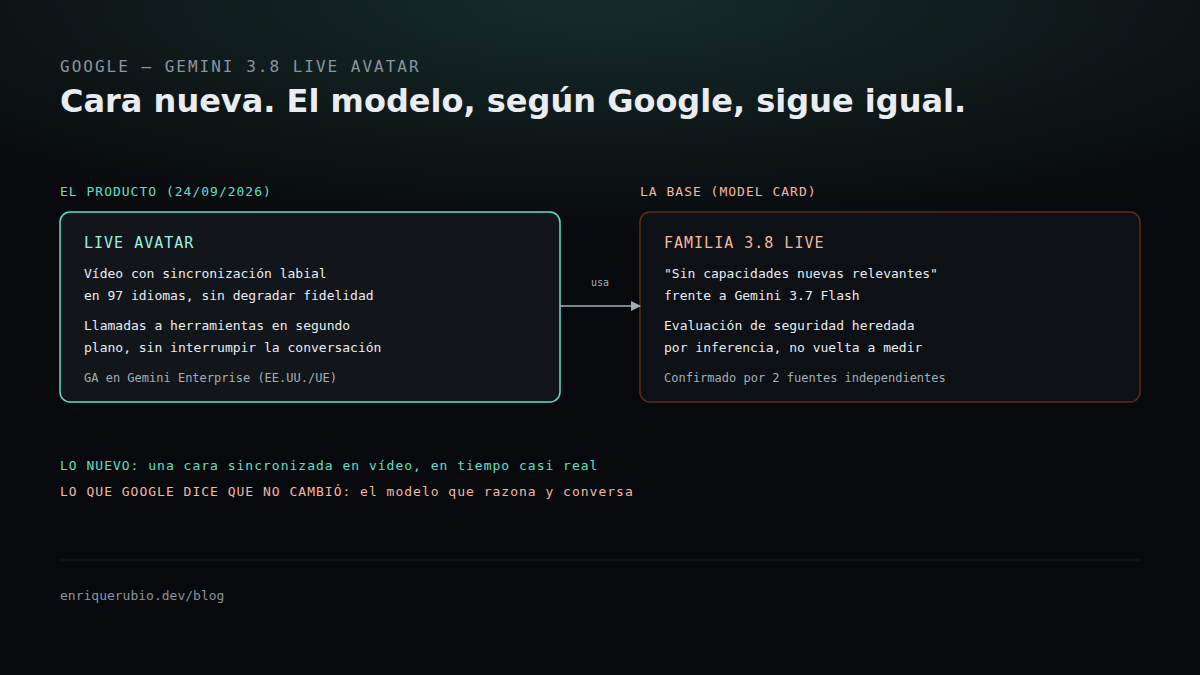
Per Google’s own announcement, Live Avatar processes audio and visual input simultaneously and responds with matching audio and video, featuring “precise lip-syncing, natural expressions, and fluid turn-taking.” Lip-sync and expression adapt dynamically across all 97 supported languages “without degrading video fidelity,” and the system can run tool calls – checking an inventory database, say – in the background without interrupting the ongoing conversation. Organizations can generate custom avatars from reference images, though that path currently requires enterprise allowlisting and verification by Google; a library of preset avatar characters is available without that gate. Every generated output carries a SynthID watermark meant to be imperceptible to viewers but detectable by Google’s own provenance tooling. According to specialized coverage (Unite.AI), the feature deploys across web, mobile, and interactive kiosks, with endpoints live in the United States and the European Union.
Live Avatar arrives nine days after Google’s September 15 launch of the base Gemini 3.8 Live and Gemini 3.8 Live Extended Thinking models – the former built for fluid, cost-efficient conversation, the latter for multi-step reasoning tasks, narrating its own progress as it works. Both were already available to developers through the Gemini API and Google AI Studio, and to consumers through Gemini Live and Google Workspace (Pro/Ultra tiers).
The Admission That Didn’t Make Any Headline
Here’s the part no press coverage led with: the Frontier Safety Framework assessment covering the entire Gemini 3.8 Live family – including the audio model Live Avatar runs on – concludes that these models have “no meaningful new capabilities or material increases in performance” compared with Gemini 3.7 Flash. Two independent outlets, Unite.AI and eesel.ai, separately quote that same line from Google’s own model card, and both add an equally important methodological detail: Google’s safety team didn’t re-run the full evaluation on the new model. Instead, the team reasoned that since there are no meaningful new capabilities, the safety results already measured for 3.7 Flash still apply by extension. That’s an inference, not a fresh measurement – a distinction eesel.ai calls “the kind of detail that separates reading the primary source from rewriting the press release.”
Why the Architecture, Not the Face, Is the Real Story
None of this means Live Avatar itself is a hollow trick – generating synchronized facial video in near real time, across 97 languages, without visible degradation, is a genuine engineering problem that Synthesia, HeyGen, and similar companies have spent years trying to solve with dedicated products. What’s interesting is where that capability now lives: Google is building it directly into the conversational model layer – the same layer already handling audio, visual understanding, and tool calling – rather than chaining a separate language model to an external avatar tool, which is closer to how most third-party AI video platforms operate today. That native integration is the real product innovation in this launch. What Google itself says did not change is the intelligence underneath: the reasoning, the comprehension, the baseline conversational ability remains, by its own account, essentially what 3.7 Flash already had.
What This Means If You’re Evaluating It
If your organization is looking at Live Avatar for customer service or a visual assistant, it’s worth separating two different questions before deciding. Does a synchronized, multilingual face solve a real integration problem you’d otherwise have to build yourself? Probably yes – that’s the concrete value here. Are you also buying a capability jump in the model that reasons and converses behind that face? According to Google’s own safety report, no – so response quality, reasoning depth, and safety limits shouldn’t be evaluated as if they’re new just because the interface looks new. It’s also worth remembering that custom avatar generation still sits behind an enterprise allowlist today, not self-serve access – so real-world availability, beyond the demo, still depends on Google approving access case by case.
Sources: Google — Introducing Gemini 3.8 Live with Live Avatar, Google — Gemini 3.8 Live and Gemini 3.8 Live Extended Thinking, Unite.AI — Google Brings Live Avatar Visual Presence to Gemini 3.8 Live, eesel AI — Gemini 3.8 Flash review 2026: benchmarks, pricing, and the catch.